
PTO Drive Shaft for Wood Chippers: Engineering Power from Tractor to Tool
A focused look at how heavy-duty PTO drive shafts deliver the torque, durability and operational reliability that professional wood chipping demands — across UK forestry, land clearance, arboriculture and biomass operations.
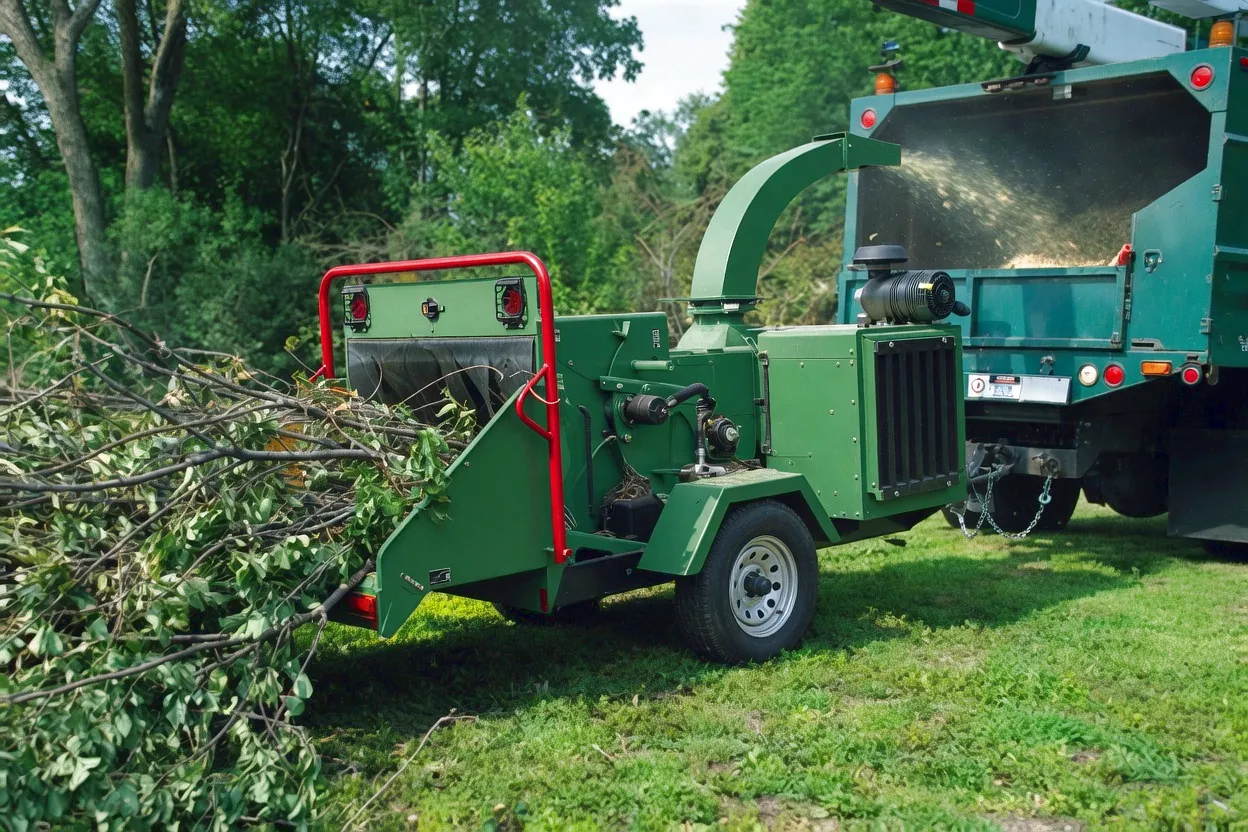
How a PTO Drive Shaft Works in a Wood Chipper Setup
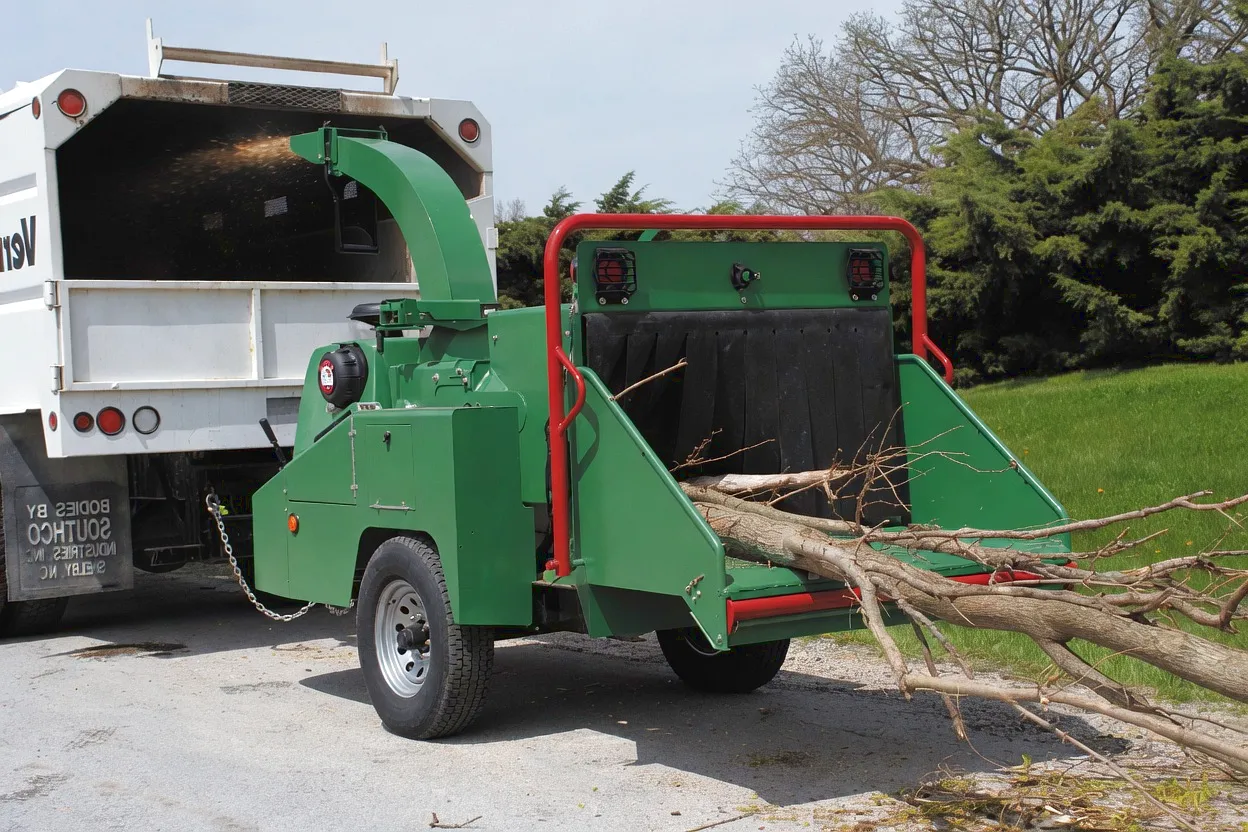
Core Materials That Define Shaft Performance
Chromium-Molybdenum (Cr-Mo) Steel Tubes
The outer and inner profile tubes that form the telescoping assembly are typically drawn from 42CrMo4 or 40Cr alloy steel. These grades offer a tensile strength range of 900–1,100 MPa after heat treatment, combined with excellent fatigue resistance under the cyclical bending and torsional loads that wood chipper operation constantly generates. The tube profile — whether lemon, star, triangular or square — is precision-formed to ensure close sliding tolerances that prevent backlash while still allowing the shaft to extend and contract freely even when contaminated with sawdust and wood fibre.
Forged Alloy Steel Yokes and Crosses
The yokes that connect to the tractor stub shaft and the chipper input shaft, along with the cross-and-bearing assemblies inside each U-joint, are made from closed-die forged 20CrMnTi or 35CrMo steel and then induction-hardened at the journal surfaces. This produces a bearing surface hardness of 58–62 HRC with a tough, ductile core underneath — exactly the combination needed when a rotor jam transfers an enormous shock impulse through the drive line in a fraction of a second. Inferior cast yokes crack under this kind of load; properly forged and heat-treated yokes absorb and redirect the energy without fracture.
HDPE Safety Guards
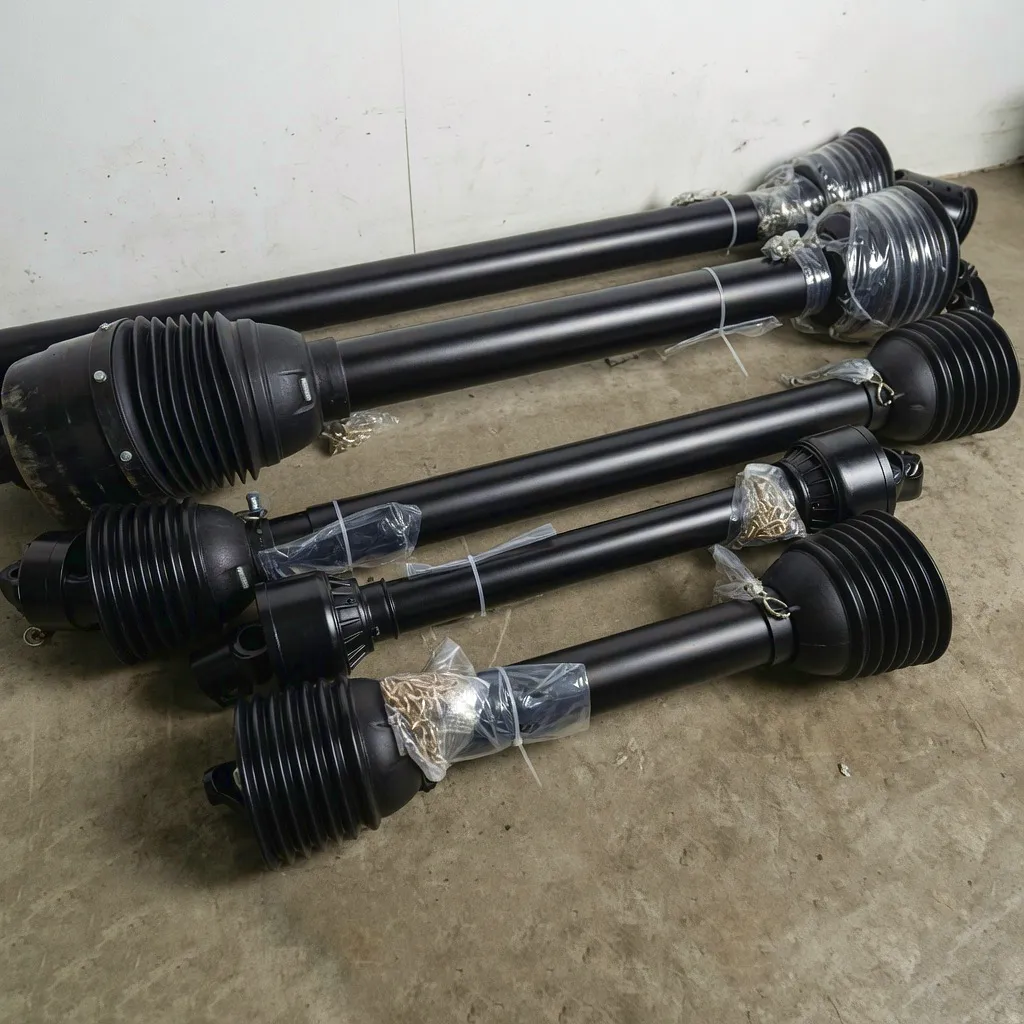
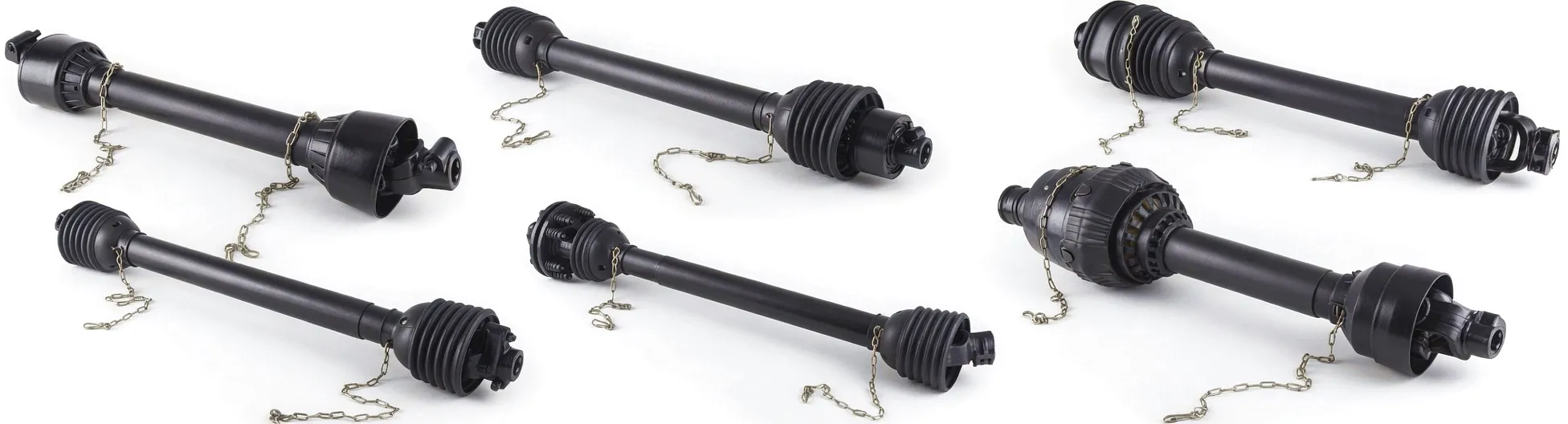
UK Health and Safety Executive regulations require all tractor PTO shafts used in professional and agricultural operations to be fitted with full-coverage safety guards. High-density polyethylene (HDPE) cone and tube guard assemblies are moulded to be impact-resistant, UV-stable, and light enough not to add meaningful rotating mass. They are retained by anti-rotation chains anchored to the machine frame and designed to stop rotating along with the shaft if entanglement occurs, preventing the catastrophic injuries that bare rotating shafts can cause. Specifying a shaft with CE-marked HDPE guards is a legal and ethical requirement for any UK operator.
Sealed Bearing Packs and Grease Nipples
Needle roller bearing packs within each U-joint cross are typically sealed with double-lip rubber seals and pre-packed with high-temperature lithium-complex grease. Grease nipples allow periodic re-lubrication on-site — critical in wet UK conditions where water ingress accelerates bearing corrosion. Some heavy-duty shafts designed for intensive wood chipper use also incorporate a grease relief valve at the cross centre, which expels contaminated grease outward rather than allowing it to accumulate inside the bearing race. In high-cycle operations such as biomass chipping for energy plants near Sheffield or Coventry, this detail can meaningfully extend bearing service life.
Core Technical Advantages for Wood Chipper Operations
Phased double-joint geometry cancels the cyclic velocity fluctuation inherent in single U-joints, keeping the chipper rotor spinning at uniform speed. This reduces vibration transmitted back to the tractor, prolongs chipper knife and anvil life, and produces a more consistent chip size — important for biomass energy buyers in the UK who specify chip grade by dimension.
Integrated friction clutch or shear-bolt hub absorbs rotor jam events before shock torque reaches the tractor PTO gearbox. This single feature alone can prevent gearbox replacements costing several thousand pounds — a recurring expense for contractors who regularly process green hardwood or root-ball material without overload protection on their shafts.
Profile tube overlap adjusts the working length of the PTO drive shaft as the chipper is manoeuvred around obstacles or over uneven woodland ground. The overlap range must be at least 1/3 of the inner tube length to prevent separation, and the tube profile geometry (lemon, star, or triangular) determines how much torque can be transmitted before the spline-equivalent begins to slip or deform under load.
Heavy-duty wood chipper PTO shafts accommodate continuous operating angles up to 25 degrees and momentary angles up to 35 degrees. This range allows contractors to navigate uneven terrain, articulate around trees and stumps, and couple up to chippers mounted at non-standard attachment heights — all without stressing the U-joint bearing races beyond their rated load envelope.
Tubes and yokes receive hot-dip galvanisation or heavy-duty epoxy powder coating, rated to withstand salt spray for 500 hours minimum per ISO 9227. In the persistently damp British climate — from Scottish hill-ground clearance work to waterlogged autumn forestry in the Chilterns — this surface protection genuinely extends component life and maintains the ease of telescoping movement over many seasons.
Every shaft supplied for the UK market carries CE marking under Machinery Directive 2006/42/EC, with HDPE guard cones and tubes covering all rotating surfaces from yoke to yoke. Anti-rotation chains are rated and positioned per ISO 5674. UK farm inspectors and forestry contractors operating under FISA codes will find the documentation straightforward to file for COSHH and equipment risk assessments.
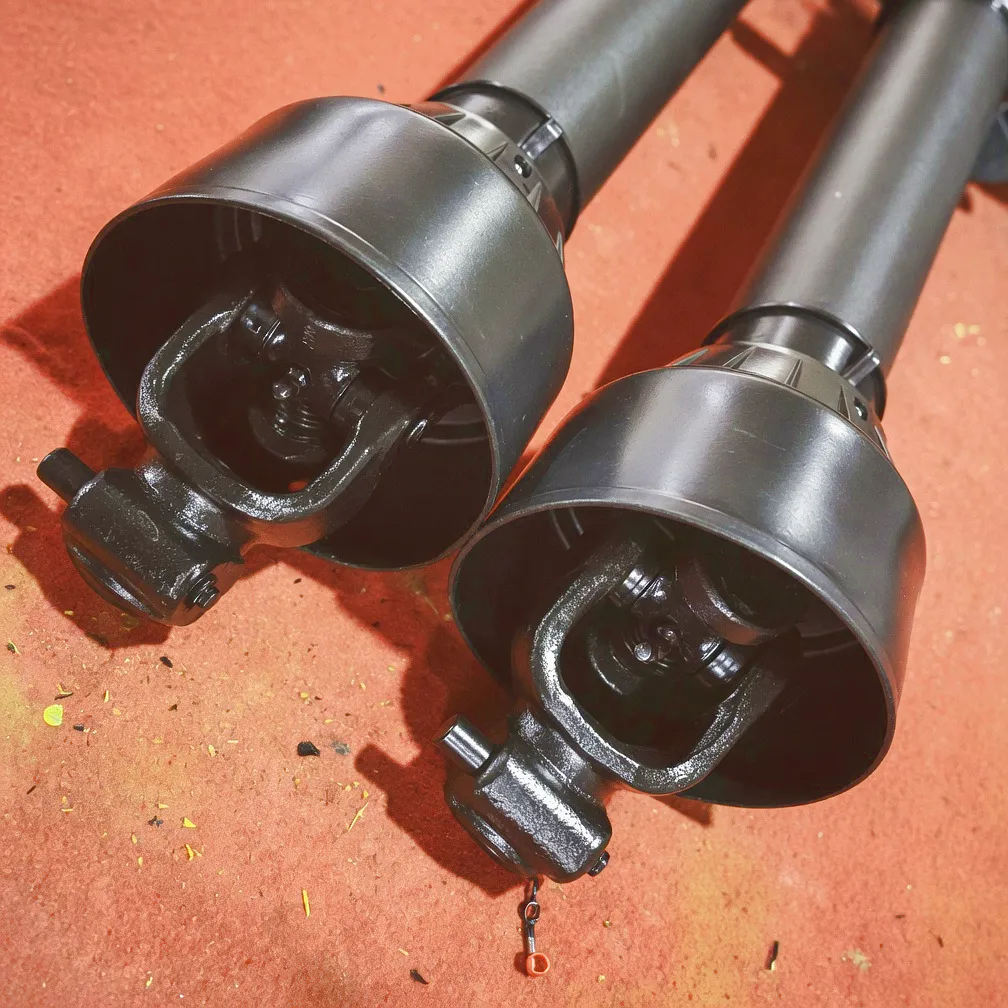
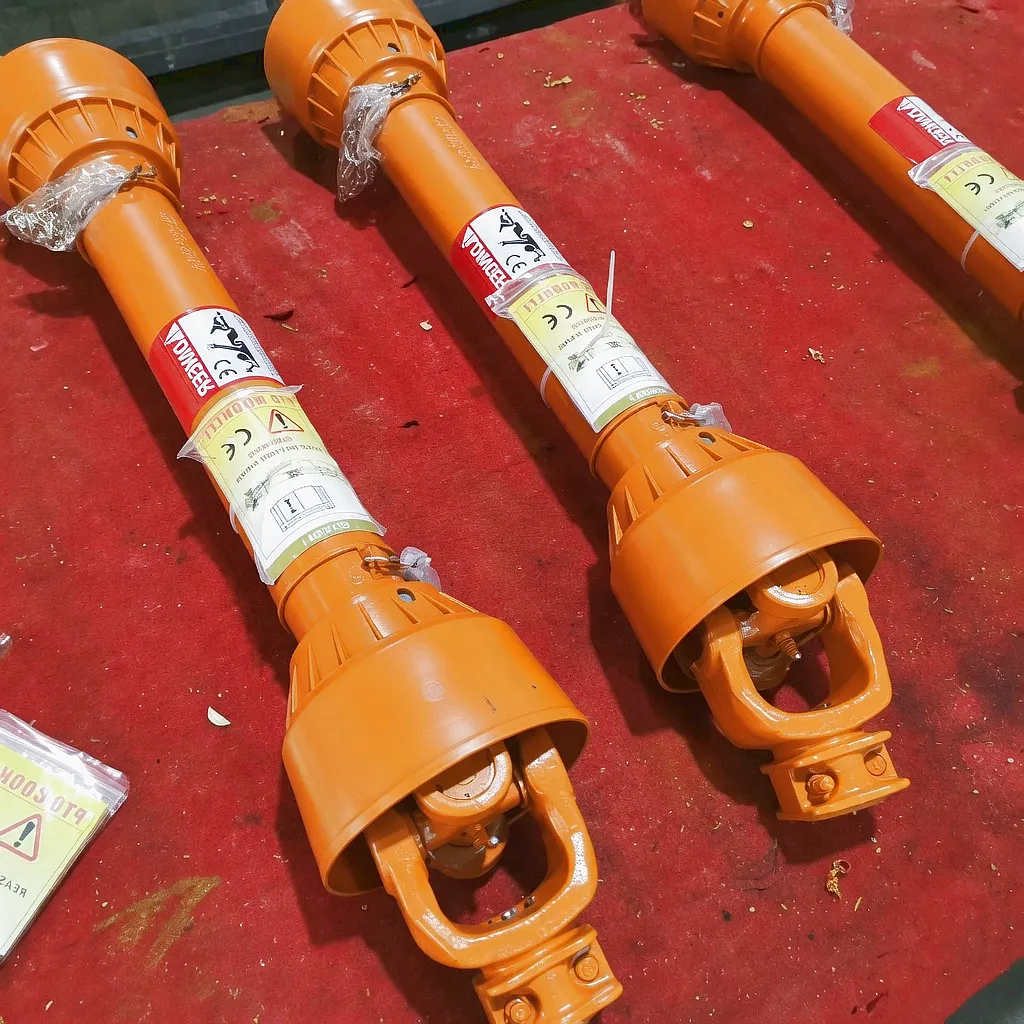
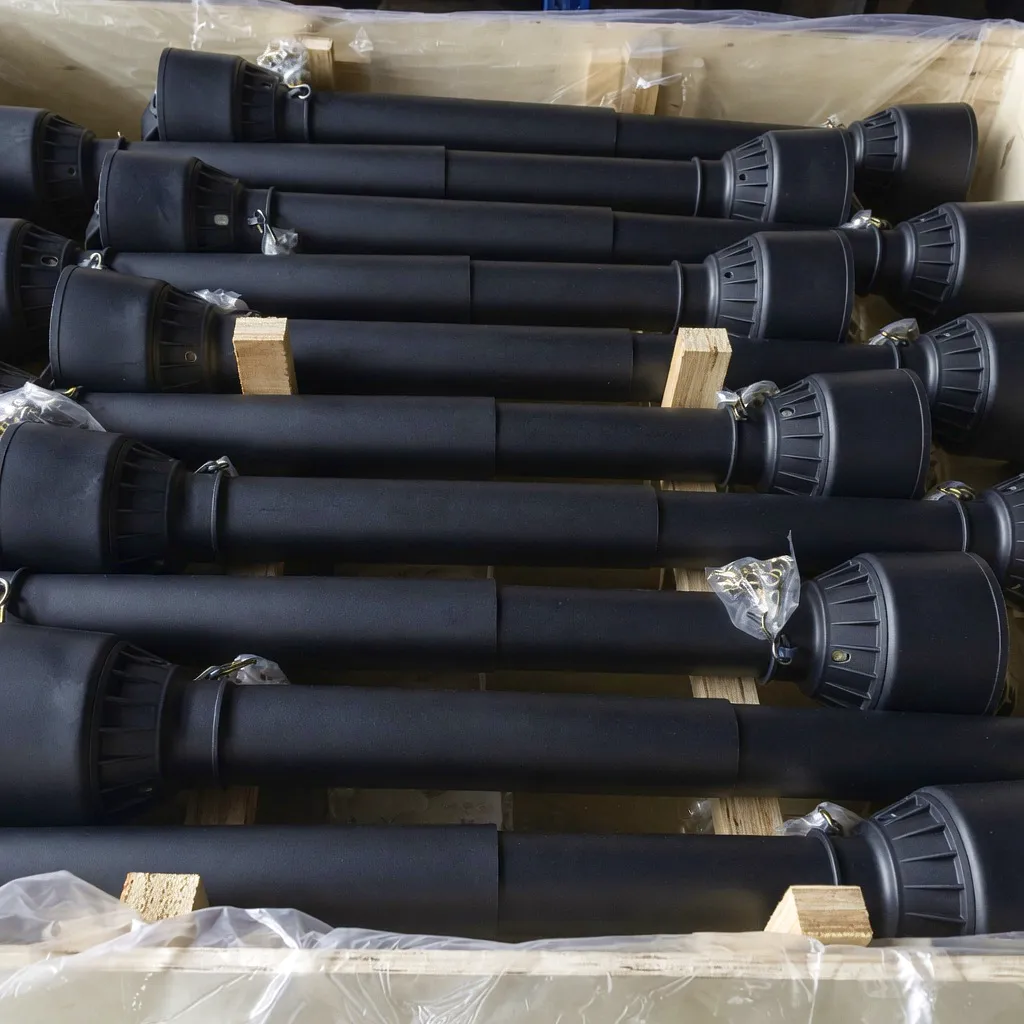
Technical Performance Parameters for Wood Chipper PTO Drive Shafts
The table below covers the primary specification ranges for PTO drive shafts used in wood chipper applications from compact tractor-mounted units through to high-capacity commercial drum chippers. Values represent the most common configurations; custom designs can extend beyond these ranges.
| Parameter | Light Duty (compact) | Medium Duty | Heavy Duty (commercial) |
|---|---|---|---|
| Rated PTO Speed | 540 rpm | 540 / 1000 rpm | 1000 rpm |
| Max Rated Torque | 450 Nm | 900 Nm | 2,200+ Nm |
| Peak Shock Torque (overload) | up to 1,200 Nm | up to 2,400 Nm | up to 6,000 Nm |
| Collapsed Length | 480–700 mm | 600–900 mm | 700–1,200 mm |
| Extended Length | up to 1,100 mm | up to 1,500 mm | up to 2,000 mm |
| Max Operating Angle (continuous) | 15 deg | 20 deg | 25 deg |
| Tube Profile | Lemon / Star | Star / Triangular | Triangular / Square |
| Overload Protection Type | Shear bolt hub | Friction clutch | Multi-disc friction clutch |
| Tube Material | 40Cr steel | 42CrMo4 steel | 42CrMo4 / 20MnCr5 |
| Yoke Spline (PTO end) | 6-spline 1-3/8 in | 6/21-spline 1-3/8 or 1-3/4 in | 21-spline 1-3/4 in |
| Surface Treatment | Powder coat | Epoxy coat / galvanised | Hot-dip galvanised |
| Certification | CE marked | CE marked, ISO 5674 | CE, ISO 5674, ASABE S318 |
Application Scenarios: Where PTO Drive Shafts Meet Wood Chippers
Wood chipping is not a single, uniform activity. The term covers a wide range of end uses — from small arborist operations trimming garden trees in suburban Birmingham to large-scale commercial biomass harvesting contracts supplying Drax and other UK energy generators. Below are the principal scenarios where a high-quality PTO drive shaft is the difference between productive chipping and costly breakdowns.
SCENARIO 01
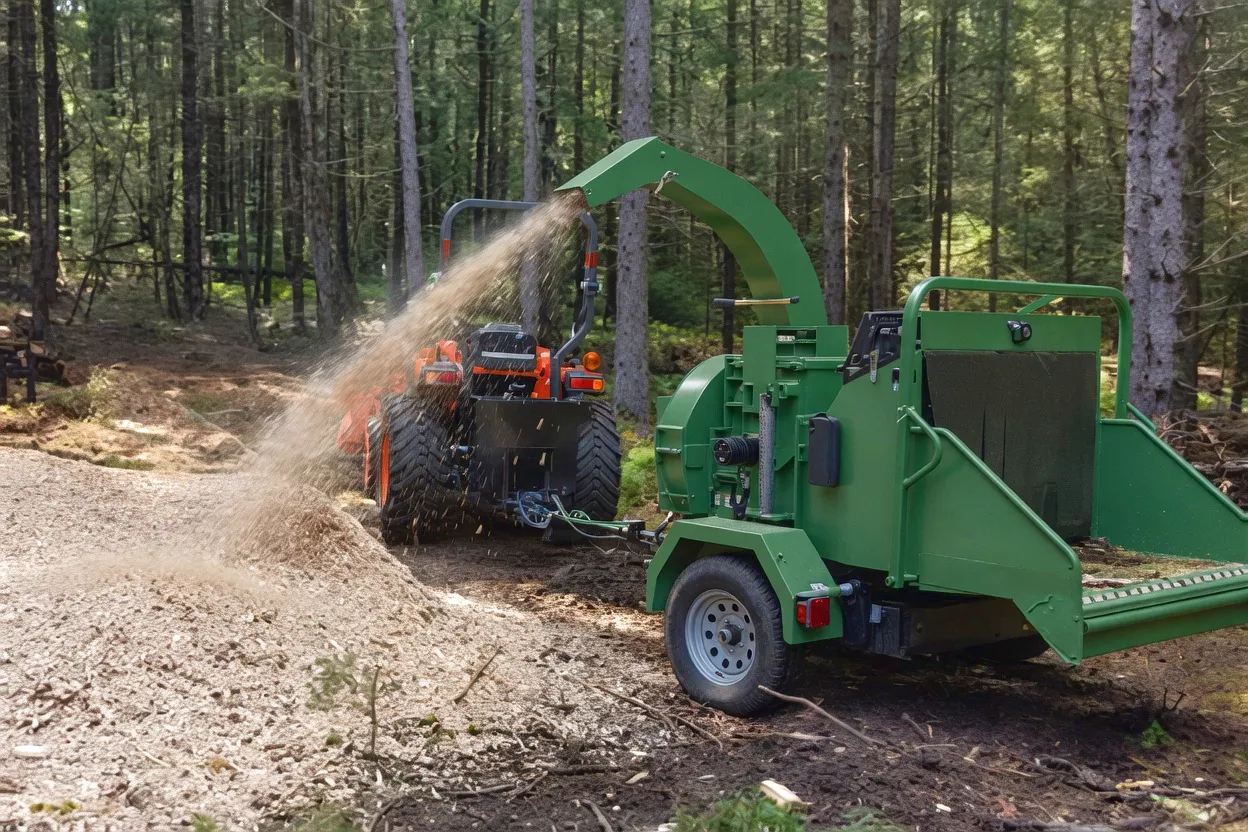
Arboricultural Wood Chipping — Residential and Urban Tree Surgery
SCENARIO 02
Forestry Residue Processing and Woodland Thinning
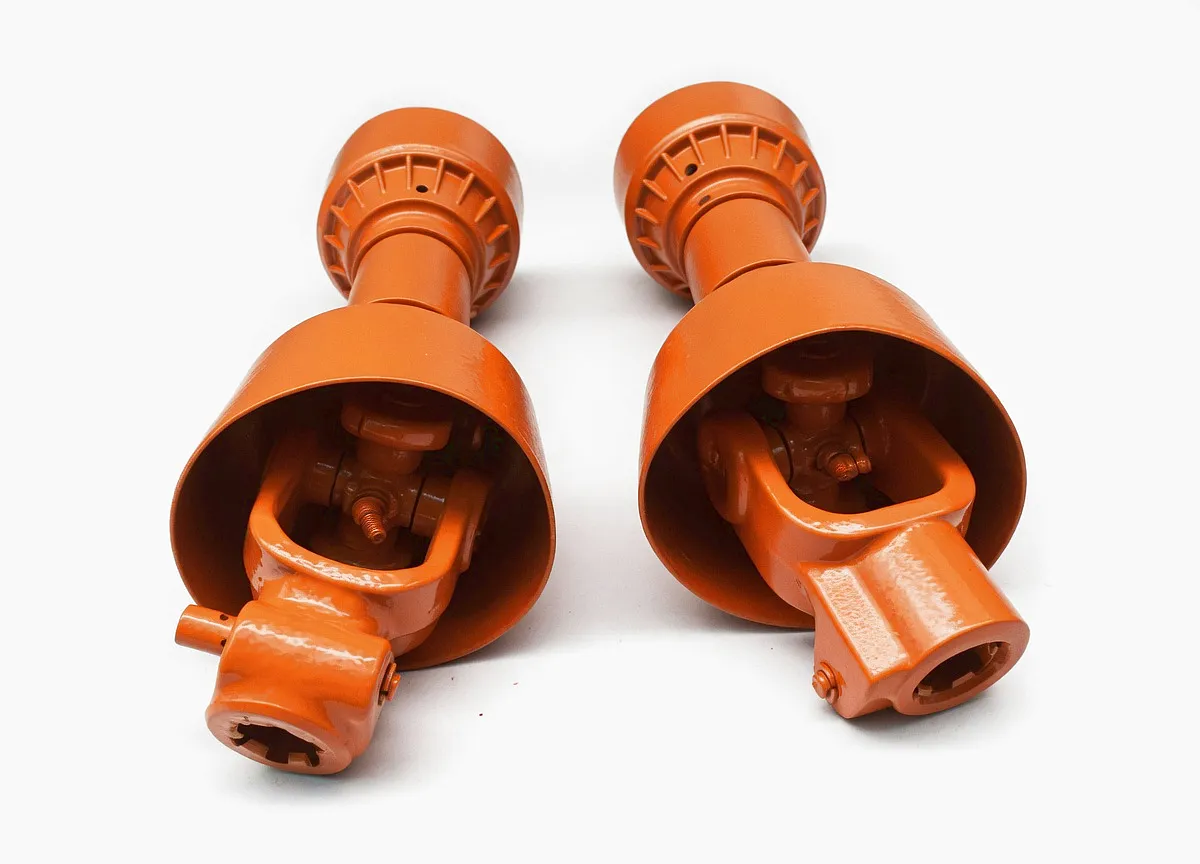 Commercial forestry operations across Scotland, Wales and northern England generate large volumes of brash — the tops and side branches left behind after felling — that need to be chipped on-site to prevent pest harbourage and facilitate restocking. The environments are demanding: waterlogged ground, steep slopes, and distances from the nearest workshop that mean a breakdown can cost hours of lost production. PTO drive shafts deployed in forestry residue chipping operations must tolerate sustained high loads, since forestry-grade chippers typically run continuous feeds of heavy conifer branches at full tractor power for hours at a stretch.
The telescoping length is especially critical here. Forestry machinery frequently operates on articulated tractors or tracked carriers, and the coupling geometry can change significantly as the vehicle navigates around stumps and over root ridges. A shaft with a generous extension range — and correctly phased U-joints that remain within their angular rating throughout that range — will outlast a shorter, cheaper shaft several times over in this environment. Many Scottish forestry contractors have moved to heavy-duty PTO drive shafts with multi-disc friction clutches rated to 1,800–2,200 Nm as standard specification on their chipping outfits, having learned through costly experience that the savings on a lighter shaft disappear after the first gearbox replacement.
SCENARIO 03
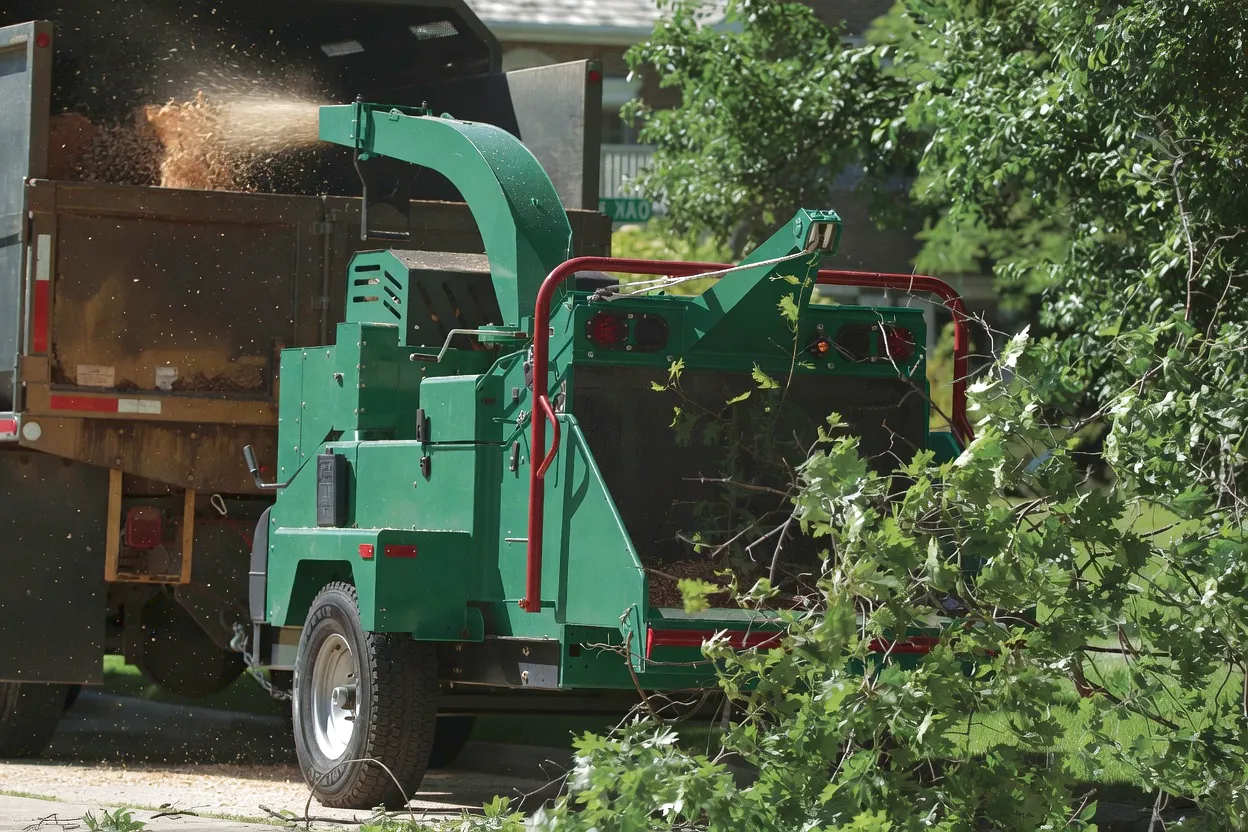
Biomass Chip Production for Energy — Commercial Scale
SCENARIO 04
Land Clearance and Habitat Management on UK Estates
 Large private estates across the Scottish Borders, the North Yorkshire Moors and the Welsh Marches regularly undertake scrub clearance, hedgerow renovation and invasive species removal programmes — often with significant volumes of hawthorn, blackthorn, gorse and willow to process. These species are notoriously abrasive and unpredictable to chip: gorse in particular tends to ball up and stall a chipper without warning, while dense hawthorn can hide embedded barbed wire that jams a rotor with extreme violence. The PTO drive shaft is the last line of mechanical defence before these shock events reach the tractor.
Estate gamekeepers and conservation contractors in these regions have increasingly adopted heavy-duty PTO drive shafts fitted with fast-acting friction clutches over earlier shear-bolt designs, because the number of overload events per day can be high enough that replacing shear bolts becomes a significant time cost. A well-adjusted friction clutch — set to trip cleanly at around 1.5 times the normal running torque — can reset itself automatically and allow chipping to continue within seconds of a jam clearance, without the operator needing to climb off the tractor, locate a spare bolt, and re-engage the coupling. Over a full day’s estate clearance work, this operational difference is genuinely significant.
SCENARIO 05
Orchard Pruning Waste Processing — Fruit and Nut Growing Regions
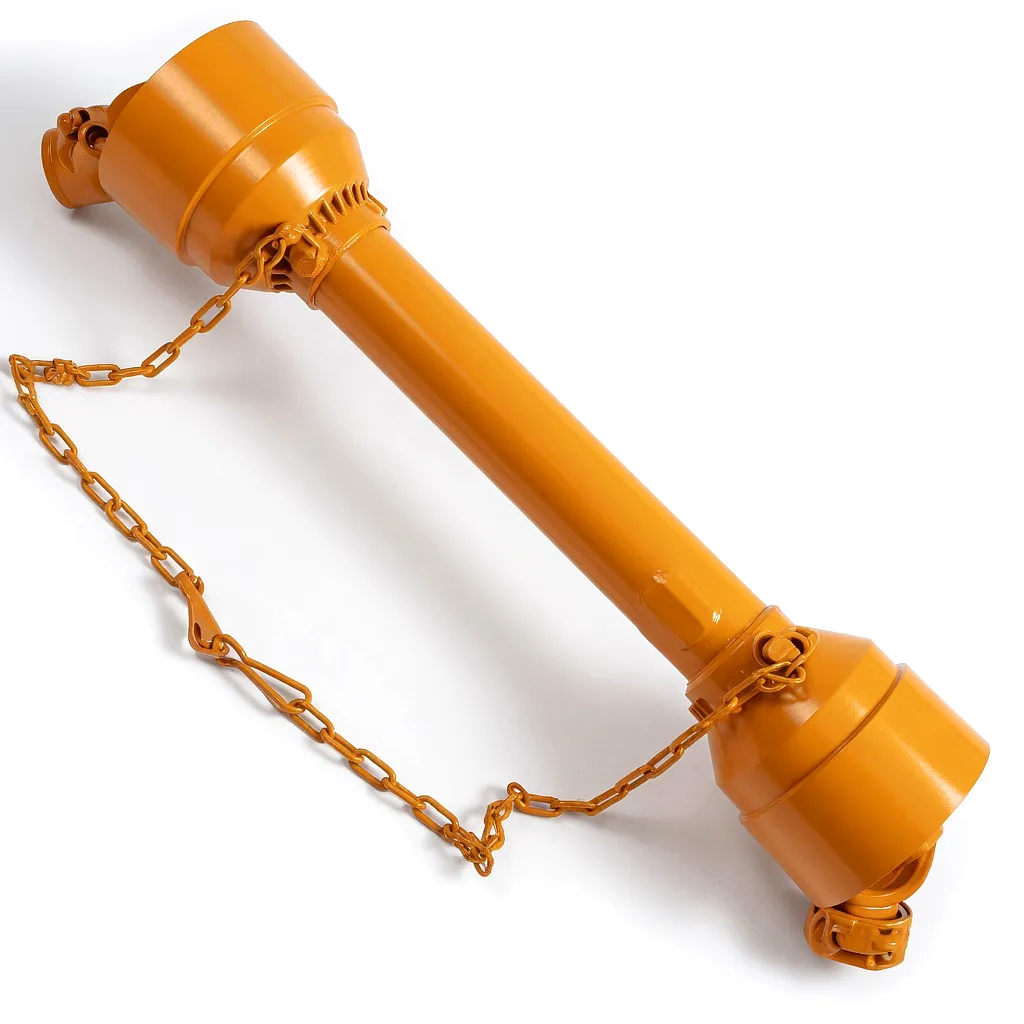 The fruit growing regions of Kent, Worcestershire, Herefordshire and the Vale of Evesham generate enormous volumes of orchard pruning waste each winter — apple, pear, cherry, plum and hazel coppard poles that need to be removed efficiently to prevent fungal disease carryover. Tractor-mounted disc chippers are the tool of choice, and they are typically operated in tight inter-row spaces where the shaft must articulate through relatively large angles as the tractor turns around headlands between narrow rows. A PTO drive shaft with a maximum continuous operating angle of at least 20 degrees is the minimum specification for this geometry, and the guard cone profile needs to accommodate the close-coupled coupling distances found when a chipper is rear-mounted on a compact orchard tractor.
The pruning seasons are short and weather-dependent. Growers in Worcestershire and Kent do not have the luxury of waiting a week for a replacement shaft to arrive from a distant supplier when theirs fails mid-season. Working with a supply partner who maintains a comprehensive stock of yoke adapters, replacement cross assemblies, guard sections and friction clutch components in the UK is not merely convenient — it is a production continuity requirement. This is one reason why an increasing number of horticultural machinery dealers in the South East and West Midlands have moved toward sourcing PTO drive shafts from manufacturers with responsive UK-oriented logistics capability.
Ever Power: Precision Engineering for Demanding Drive Line Specifications
Ever Power has spent decades refining its PTO drive shaft manufacturing processes specifically for high-shock, high-cycle applications like wood chippers. The production facility operates cold-drawing lines for profile tube production, automated CNC machining centres for yoke and cross assembly, induction hardening stations, and a dedicated assembly and test area where completed shafts are torque-tested before despatch. Every shaft leaves the factory with traceable material certification, dimensional inspection records and test data — documentation that UK buyers increasingly require from their supply chains.
Where Ever Power genuinely differentiates itself is in customisation capability. The UK wood chipper market is not homogeneous — chipper manufacturers specify wildly different input shaft diameters, spline counts, yoke face configurations and torque ratings across their product ranges. A shaft that bolts directly onto one brand’s chipper may require a different yoke bore, a different overload clutch trip torque, and a different collapsed length to work correctly on another. Ever Power’s engineering team works directly with customers to engineer shaft assemblies that fit precisely rather than requiring field modification, and can produce small batch orders of custom specifications from as few as ten pieces — a minimum quantity that suits independent chipper dealers and machinery hire companies without committing to container-quantity stock.
The supply chain infrastructure is structured to support UK buyers with competitive lead times and responsive technical support. Drawings, 3D models, material certificates and test reports are provided as standard with every order. For distributors supplying the arboriculture and forestry markets in the UK, Ever Power also provides co-engineering support for own-brand labelled products — an option that gives dealers the ability to offer a differentiated shaft specification under their own brand without establishing a separate manufacturing operation.
Customer Success: Herefordshire Biomass Contracting Firm Reduces Downtime by 60%
A family-run agricultural contracting business based near Leominster in Herefordshire had been operating a mixed fleet of tractor-mounted disc and drum chippers for several years, supplying woodchip fuel to three district heating networks across the county. Their primary chipper — a 200 hp-class drum unit capable of processing material up to 350 mm in diameter — was experiencing PTO drive shaft failures every three to four months on average. The root cause was a combination of: a shaft specification rated below the actual peak torque generated during hardwood jam events; a yoke bore worn beyond tolerance due to fretting from a mismatched spline fit; and HDPE guard sections that were splitting and creating a secondary safety hazard during operation.
After contacting Ever Power’s technical sales team, the contractor shared the chipper’s input shaft specification drawings, their typical operating torque data from the tractor ISOBUS monitor, and a description of the most common failure mode. Ever Power’s engineers reviewed the data and identified that the correct solution required a heavy-duty shaft rated to 2,400 Nm continuous torque with a multi-disc friction clutch set at 3,200 Nm trip torque — considerably above what the contractor had been fitting. A custom 21-spline 1-3/4 inch yoke was matched to the chipper’s input shaft geometry, and the collapsed length was adjusted to suit the contractor’s specific tractor-to-chipper coupling distance, which was shorter than the standard catalogue dimension.
The new specification shafts were delivered within three weeks. Over the following twelve months of operation — covering two full biomass harvest seasons and regular road transport maintenance chipping — not a single shaft failure occurred. The contractor estimated the saving at around eleven thousand pounds in shaft replacements, tractor gearbox inspection costs, and lost contract income from downtime events, against a total cost for three replacement shafts of under fourteen hundred pounds. The outcome was straightforward enough that the contractor subsequently specified the same Ever Power shaft configuration as the standard replacement part across all three chippers in the fleet.
“We had been patching together shaft repairs for two seasons before working with Ever Power. The custom-spec shaft they supplied for our drum chipper has now run through a full year of heavy biomass work without a single issue. The friction clutch is exactly the right trip torque — it has fired twice on really bad jams and reset immediately. The technical team understood our problem from the first call and the lead time was genuinely acceptable.”
“We run three tractor-mounted disc chippers for urban tree surgery contracts across Greater Manchester. The Ever Power shafts have a noticeably better spline fit on our Merlo and JCB telescopic handlers than anything we tried before. The guard cones are robust — they have taken some serious hits from kerbs and gate posts without cracking. For a business that couples and decouples a chipper five to eight times daily, build quality at the yoke ends really does matter.”
“As a machinery dealer supplying the forestry and estate management market in Perthshire and Angus, I needed a PTO shaft supplier who could provide correct documentation for our customers’ equipment inspections. Ever Power provides CE declarations, material certificates and test data as standard with each batch. Their willingness to do small custom production runs for specific chipper models has genuinely improved what we can offer our dealer customers.”
Frequently Asked Questions
The correct shaft size depends on your tractor’s power output, the chipper’s rated input torque, and the physical coupling dimensions on both machines. As a general guide, compact tractors below 80 hp typically pair with 6-spline 1-3/8 inch yoke shafts in the light-duty range (up to 450 Nm rated). Medium and high-power tractors from 80–180 hp are usually matched to 6 or 21 spline 1-3/8 or 1-3/4 inch shafts in the 900–1,500 Nm range. Commercial-grade chippers driven by 150 hp-plus tractors typically require 21-spline 1-3/4 inch heavy-duty shafts rated to 2,000 Nm or above. Always verify the chipper manufacturer’s input shaft specification before ordering.
The price for a heavy-duty PTO drive shaft suitable for a commercial drum or disc chipper in the UK typically ranges from a few hundred to over a thousand pounds, depending on torque rating, shaft length, overload clutch specification, and whether a custom yoke configuration is required. Catalogue standard shafts are the most cost-effective, while custom-engineered assemblies — needed when the chipper input shaft is a non-standard dimension — carry additional tooling and engineering costs that are usually offset by the reduction in modification work done in the field. Contact Ever Power directly for a quote specific to your chipper make and tractor specification.
For hardwood species where rotor jams are frequent, a multi-disc friction clutch set to trip at 1.3–1.5 times the running torque is generally preferred over a shear-bolt hub. The friction clutch resets itself automatically after a jam clearance, avoiding the need to replace bolts mid-operation. In situations where jam frequency is low and precise torque disconnection is preferred — for example, high-speed disc chippers where any rotational shock could damage the disc assembly — a shear-bolt hub provides a more definitive and tuneable protection threshold. For mixed hardwood woodland work in the UK, friction clutch is the practical recommendation.
CE-certified PTO drive shafts with full compliance documentation for UK forestry and arboricultural use can be sourced directly from manufacturers like Ever Power, who supply the UK market with competitive lead times and comprehensive technical documentation including CE declarations, ISO compliance records, and material certificates. For contractors in Scotland, northern England, or anywhere in the UK, the most efficient route is to contact a manufacturer’s technical sales team directly to verify the exact specification against your equipment and arrange delivery to site or a local freight depot.
The recommended service interval for U-joint bearing packs on a PTO drive shaft used in daily wood chipping is typically every 20–50 operating hours under standard conditions. In wet UK winter conditions — common across most of Scotland, Wales and northern England — the interval should be reduced to 15–25 hours since water ingress accelerates grease breakdown and bearing surface corrosion. The telescoping profile tube interface also benefits from periodic lubrication with a heavy-duty grease or dry lubricant appropriate for the tube profile material. Always check the shaft manufacturer’s service schedule as the primary reference, since bearing pack design and grease type vary between products.
Yes. Ever Power engineers custom PTO drive shaft assemblies to customer drawings or sample parts, including non-standard yoke bore diameters, keyway configurations, and face bolt patterns. All custom shafts are produced with full material traceability, dimensional inspection records, and CE declaration documentation under Machinery Directive 2006/42/EC. Minimum order quantities for custom specifications start from ten pieces, making the option viable for machinery dealers supplying the UK forestry, estate management, and arboricultural markets. Provide your chipper’s input shaft drawing or a dimensional description to the Ever Power technical team to receive a detailed price and lead time.
Ready to Specify the Right PTO Drive Shaft for Your Wood Chipper?
Share your chipper make, model, tractor horsepower, and coupling dimensions. Ever Power’s technical team will respond with a precise specification and price within one working day.