
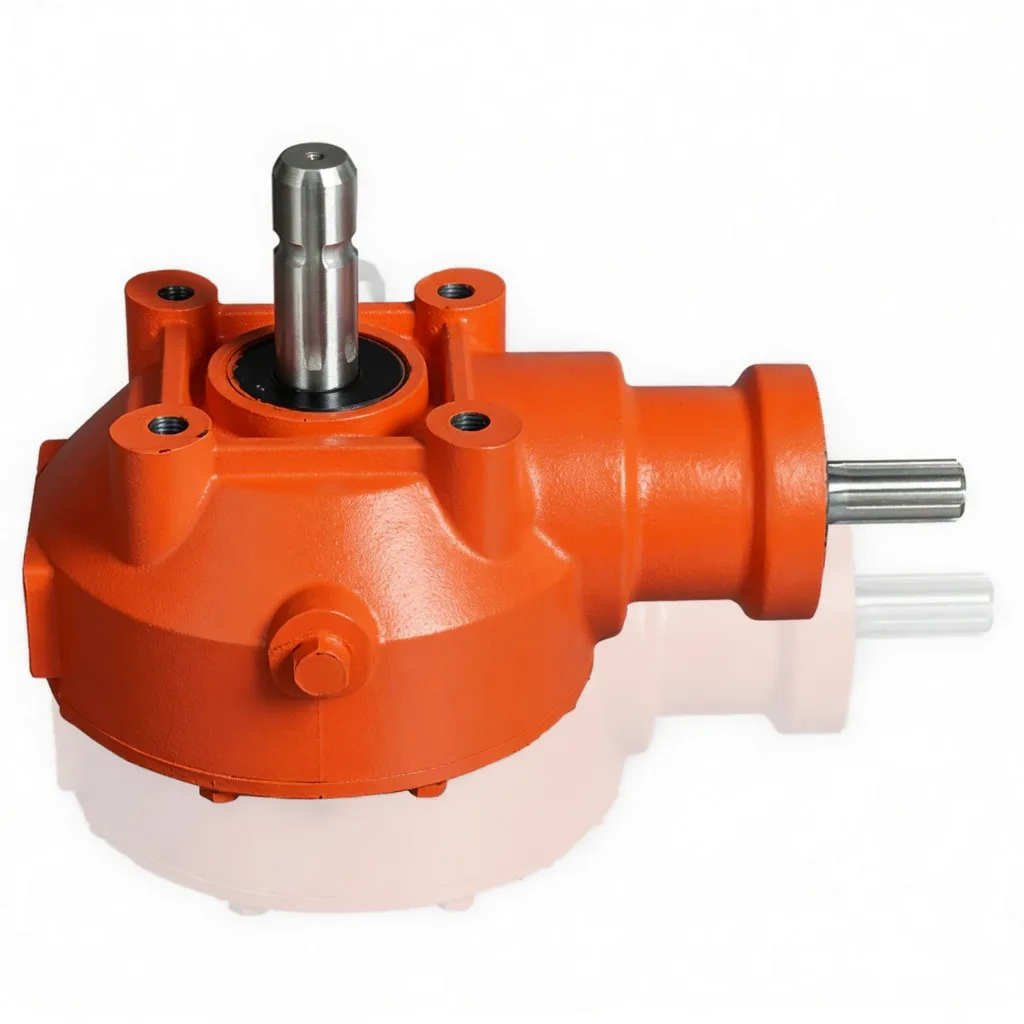
How the Row Unit Gearbox Works
Stage 1
Power Input & Bevel Stage
Drive enters the row unit gearbox through a splined input shaft, typically receiving power from a header driveline running at 540 or 1,000 rpm PTO equivalent. A set of precision-ground bevel gears — usually spiral bevel, with a 90-degree axis change — converts the horizontal shaft rotation into the vertical axis rotation needed to drive the gathering and snapping roll systems. The spiral bevel tooth geometry is specifically chosen for its quiet running characteristics and superior load distribution under impact conditions caused by wayward stones or soil clods that inevitably enter the row unit during field operation. The bevel mesh also sets the fundamental speed ratio between input and roll output, a parameter that must be matched precisely to the crop variety’s recommended peripheral snapping roll speed.
Stage 2
Spur/Helical Reduction Stage
After the bevel stage, the power is distributed to a spur or helical gear reduction set. This secondary stage achieves the final output speed and torque multiplication required for the snapping and stalk rolls. Helical gears are increasingly preferred in premium agricultural gearbox designs because the progressive tooth engagement reduces shock loading and noise, an important factor when row units are expected to operate at speeds above 6 km/h. Counter-rotating outputs are achieved through an idler arrangement, ensuring that paired stalk rolls pull the plant stalk downward with equal and opposing force — the fundamental mechanism by which the corn ear is snapped from the stalk. Precise gear mesh tolerancing, typically better than ISO Grade 7 for agricultural applications, is essential to maintain consistent output speed under varying load conditions across an entire harvesting shift.
Stage 3
Output Shafts & Sealing
The output shafts of the row unit gearbox protrude through precision-machined housing bores fitted with double-lip oil seals or radial shaft seals rated for continuous field conditions. These seals must retain the gear oil (typically SAE 80W-90 GL-5) under centrifugal sling and prevent the ingress of maize silk, leaf debris, dust, and moisture — all of which are abundant in the harvesting environment. Shaft-to-hub connections use involute splines or keyed interfaces, designed so that roll assemblies can be exchanged in the field without special tools, a practical requirement when a UK farmer needs to swap damaged rolls and be back working within the limited harvesting weather window typical of October maize campaigns in the Midlands and East of England.
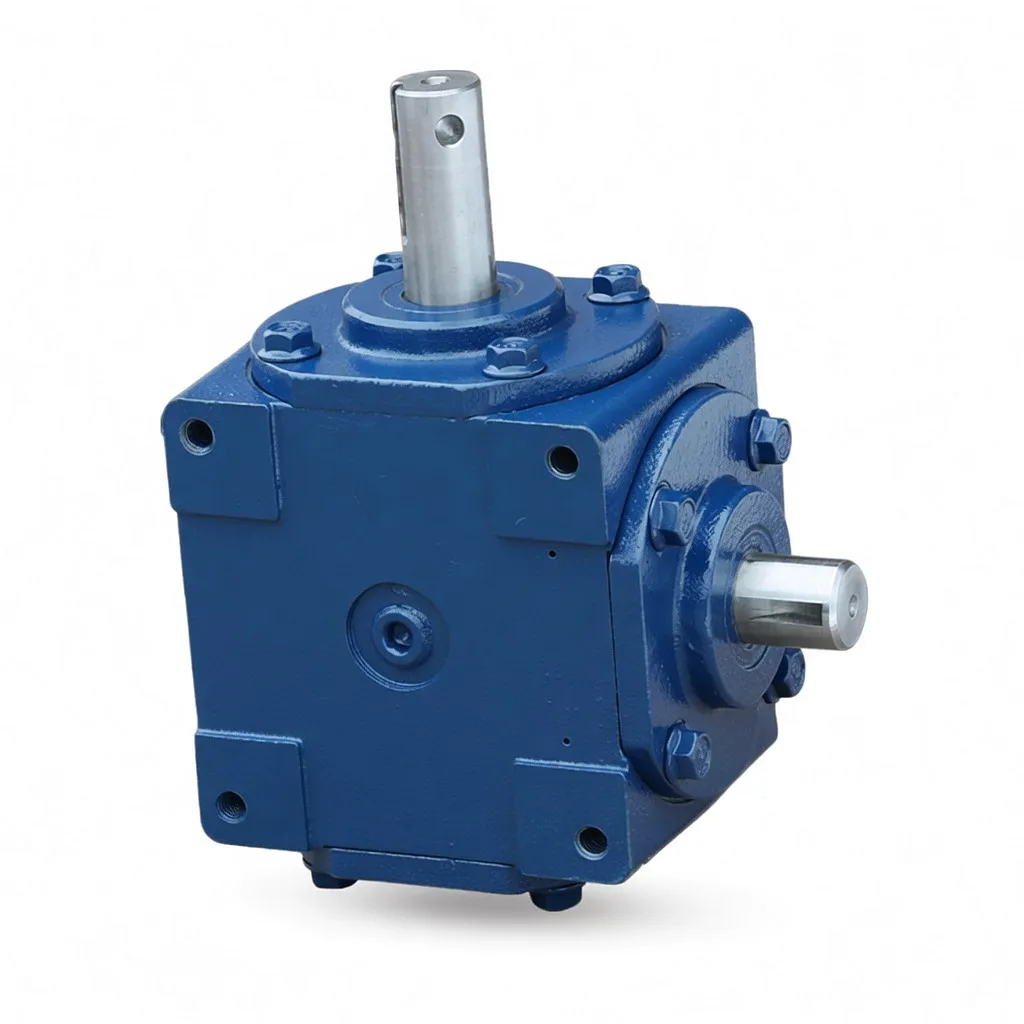
Core Materials: What Goes Into a Durable Agricultural Gearbox
Housing
GG25 grey cast iron / GGG50 nodular iron / A380 aluminium alloy
Gears
20CrMnTi / 20MnCr5 / 17CrNiMo6 — case carburised, 58–62 HRC
Shafts
42CrMo4 alloy steel, 28–34 HRC, precision-ground journals
Bearings
Tapered / deep groove ball bearings, GCr15 (SUJ2), C3 clearance
Seals
NBR / FKM double-lip radial shaft seals, IP54+ ingress protection
Lubricant
SAE 80W-90 GL-5 mineral or synthetic gear oil, field-serviceable
Product Technical & Performance Parameter Table
| Parameter | Typical Value / Range | Notes |
|---|---|---|
| Input Speed | 540 / 1,000 rpm | Matched to tractor PTO standard; 1,000 rpm increasingly common in UK |
| Output Speed (Snapping Rolls) | 350 – 850 rpm | Adjusted via ratio selection to match crop and ground speed |
| Gear Ratio (Typical) | 1.2 : 1 to 3.5 : 1 | Single or two-stage ratio; custom ratios available |
| Rated Input Torque | 150 – 650 N·m | Depends on number of outputs and header design |
| Peak / Shock Torque | Up to 3 × rated (momentary) | Stone/stalk impact; gears rated for KS > 1.5 service factor |
| Gear Accuracy Grade | ISO 1328 Grade 6 – 8 | Hobbed + shaved or ground; bevel gears lapped in pairs |
| Surface Hardness (Gears) | 58 – 62 HRC (case) | Carburised & quenched; case depth 0.8 – 1.4 mm |
| Row Spacing Compatibility | 450 mm, 500 mm, 750 mm | Standard UK/EU widths; custom housing profiles available |
| Output Shaft Diameter | 30 mm, 35 mm, 40 mm, 45 mm | Keyed or splined; matched to OEM roll bore dimensions |
| Operating Temperature | -20 °C to +80 °C continuous | UK autumn harvest; cold start and sustained load rated |
| Transmission Efficiency | > 96% per stage | Spiral bevel + helical stages; full-load thermal equilibrium achieved |
| IP Rating (Sealing) | IP54 minimum / IP65 optional | Dust-tight and splash-resistant as standard; IP65 for wet UK harvests |
| Design Life | > 3,000 operating hours | Based on rated torque, regular oil service intervals |
| Weight (Typical Unit) | 4.5 – 14 kg | Depends on ratio, output count, and housing material |
Core Technical Advantages of a High-Quality Row Unit Agricultural Gearbox
Spiral Bevel Precision
Lapped spiral bevel pairs achieve tooth bearing contact across more than 60% of the tooth face, dramatically reducing peak Hertzian stress and extending service life beyond what straight bevel designs can offer at equivalent torque levels. This translates directly to fewer mid-season gearbox failures on UK corn headers running extended shifts during the narrow autumn harvest window.
Shock Load Resilience
Case-hardened gears with a tough alloy steel core absorb the instantaneous torque spikes — often reaching three times the rated value — generated when snapping rolls encounter a double stalk or a lodged stone. The deep case profile prevents case crushing while the ductile core prevents brittle fracture, a failure mode that causes catastrophic tooth breakage and expensive field delays in less well-specified agricultural gearboxes.
Field-Proven Sealing
FKM fluoroelastomer output shaft seals maintain effective lip contact across temperature swings from a frosty October morning to sustained afternoon operating temperatures. The labyrinth pre-seal design behind the lip seal provides a secondary defence against maize silk ingress — a specific failure point in lower-quality agricultural gearboxes — dramatically extending the oil change interval and reducing seal replacement frequency across an entire season.
High Transmission Efficiency
A well-designed agricultural gearbox stage achieves over 96% mechanical efficiency, meaning that a 12-row corn header with 24 individual gearbox drives loses less than 4% of available PTO power to heat generation. At 200 kW input this represents a saving of more than 8 kW compared with designs operating at 92% efficiency — a meaningful fuel economy gain across a full UK harvesting campaign running 400 or more hours on a large arable enterprise.
Modular Interchangeability
Standardised bolt patterns, shaft sizes, and input dimensions mean that replacement units can be swapped in under 30 minutes in the field. For UK contractors running multi-farm harvest contracts across Lincolnshire or Norfolk, this capability is critical: a row unit gearbox failure at 08:00 on a dry morning should not cost the entire harvest day. Modular design also enables ratio changes during the season if a farm switches between grain maize and wholecrop silage maize, which benefit from different roll speeds.
Custom Ratio & Output Configuration
Unlike catalogue commodity gearboxes, purpose-designed row unit agricultural gearboxes can be specified with bespoke gear ratios, dual or triple output shafts, integrated overload shear bolt protection, or dedicated drives for gathering chain sprockets — all from a single compact housing. This degree of engineering flexibility makes it feasible for header OEMs and aftermarket suppliers across the UK and Europe to develop proprietary designs without investing in in-house gear cutting capability.
Application Scenario: Row Unit Gearbox in Corn Harvesters
Corn Harvester — 2.2.1 Row Unit Gearbox Application
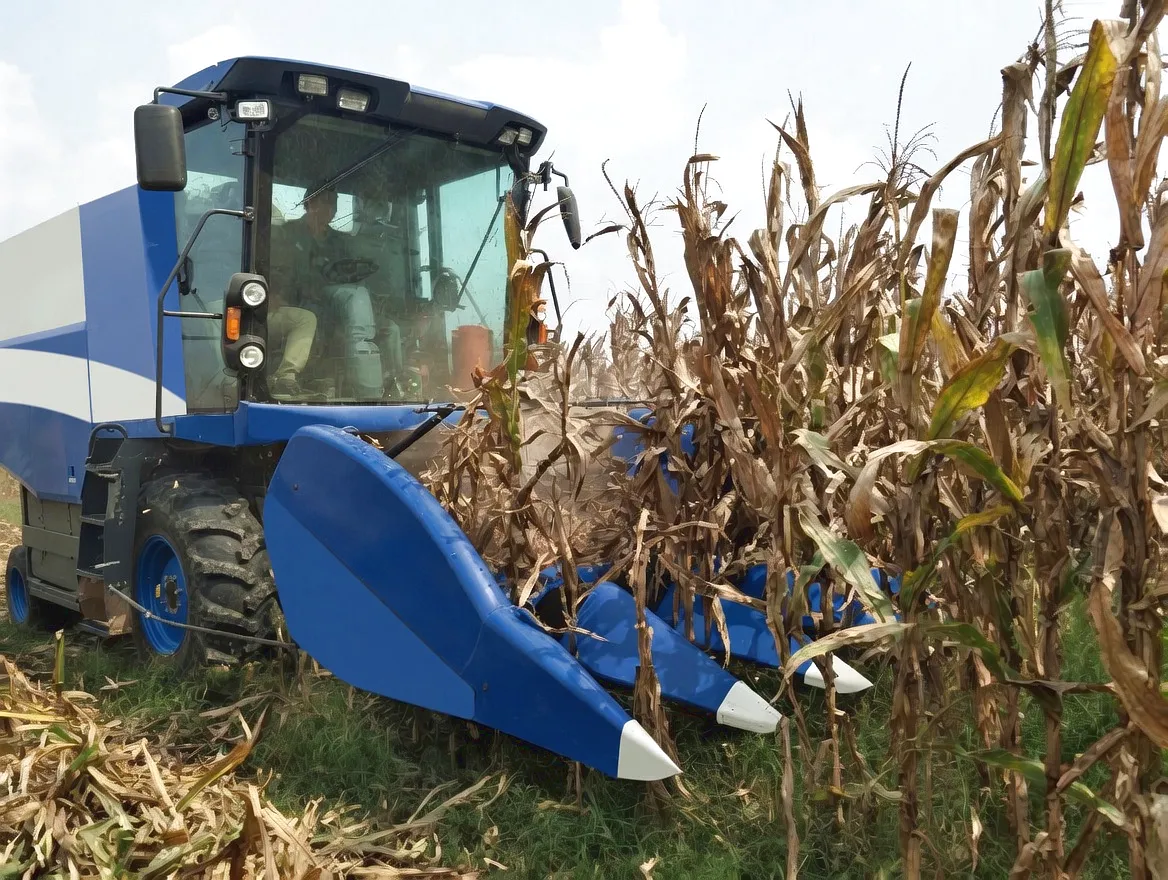 Snapping Roll Drive — The Primary Corn Separation Function
The snapping rolls are the most mechanically demanding components of any corn header, and the agricultural gearbox driving them must handle not just rated torque but the highly variable instantaneous loading profile that characterises stalk engagement. As the roll nip point contacts a fresh stalk, the load spikes sharply for approximately 80–120 milliseconds before the stalk snaps and the load drops back. Multiply this profile across six, eight, or twelve row units operating simultaneously at 1.5 m row spacing and 6 km/h forward speed, and the combined driveline torque demand becomes a complex, multi-frequency pulsating load. The row unit gearbox must absorb and transmit these pulses through its gear mesh without generating resonant torsional vibration that would otherwise propagate back into the combine header frame and mounting structure.
UK maize varieties grown for grain and wholecrop silage — including popular varieties approved under the AHDB recommended list — tend to produce stalks with higher stiffness than some Continental varieties, particularly in the drier years increasingly common under changing UK weather patterns. This demands snapping roll gearboxes with service factors of at least 1.5 and, in high-throughput contractor machines, often 2.0 or above. The ever-increasing harvesting speeds demanded by UK contractors operating across large arable farms in Lincolnshire, Nottinghamshire, and East Yorkshire mean that designing to minimum safety margins is not a viable strategy for a gearbox supplier targeting this market.
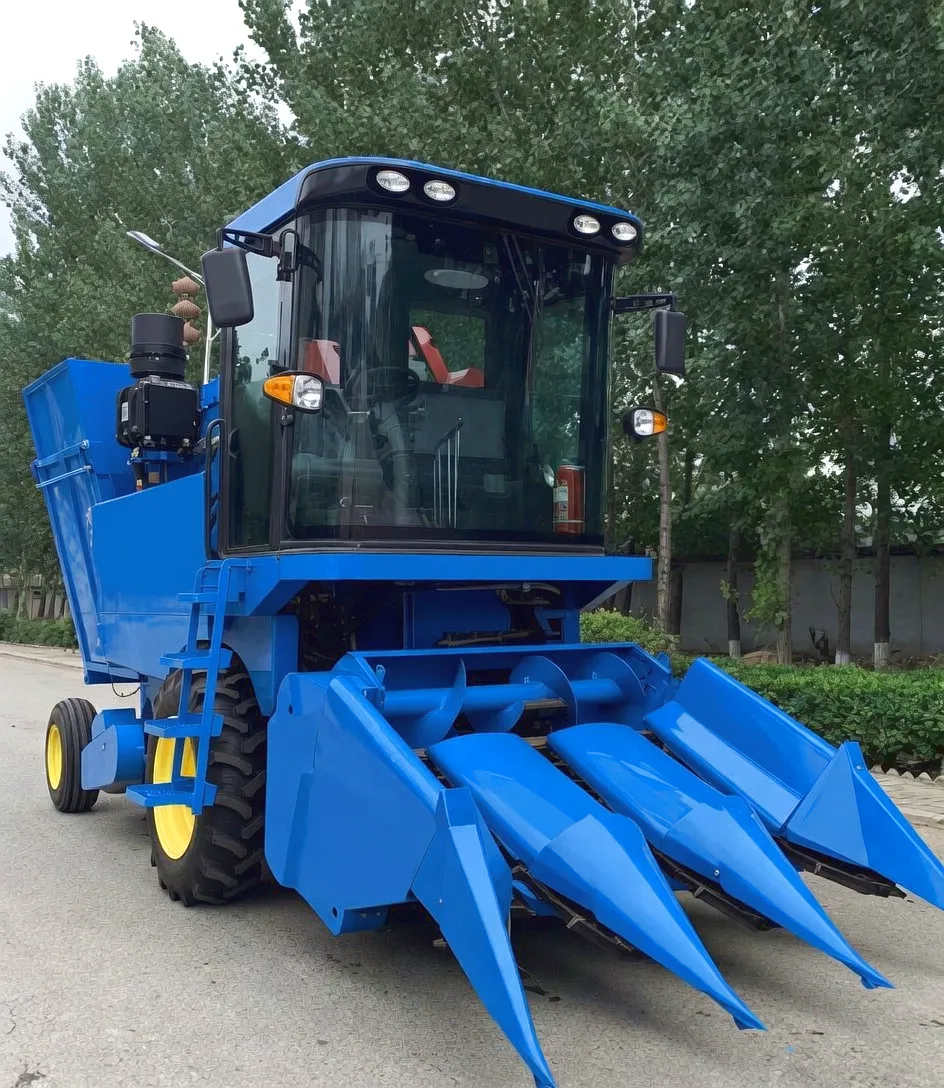 Gathering chains run along each side of the row unit, collecting erect and lodged stalks and directing them towards the snapping roll nip point. These chains operate at a surface speed carefully matched to the forward travel speed of the combine, typically 10–25% faster than ground speed to ensure that any stalks ahead of the row unit are reliably captured rather than pushed aside. The agricultural gearbox driving the gathering chain sprockets typically takes its drive from the same gearbox housing as the snapping roll output, with a separate output shaft or a chain/sprocket take-off from the primary shaft that delivers the slightly higher ratio required for chain speed synchronisation.
Counter-Rotating Stalk Roll Drive — Pulling the Plant Downward
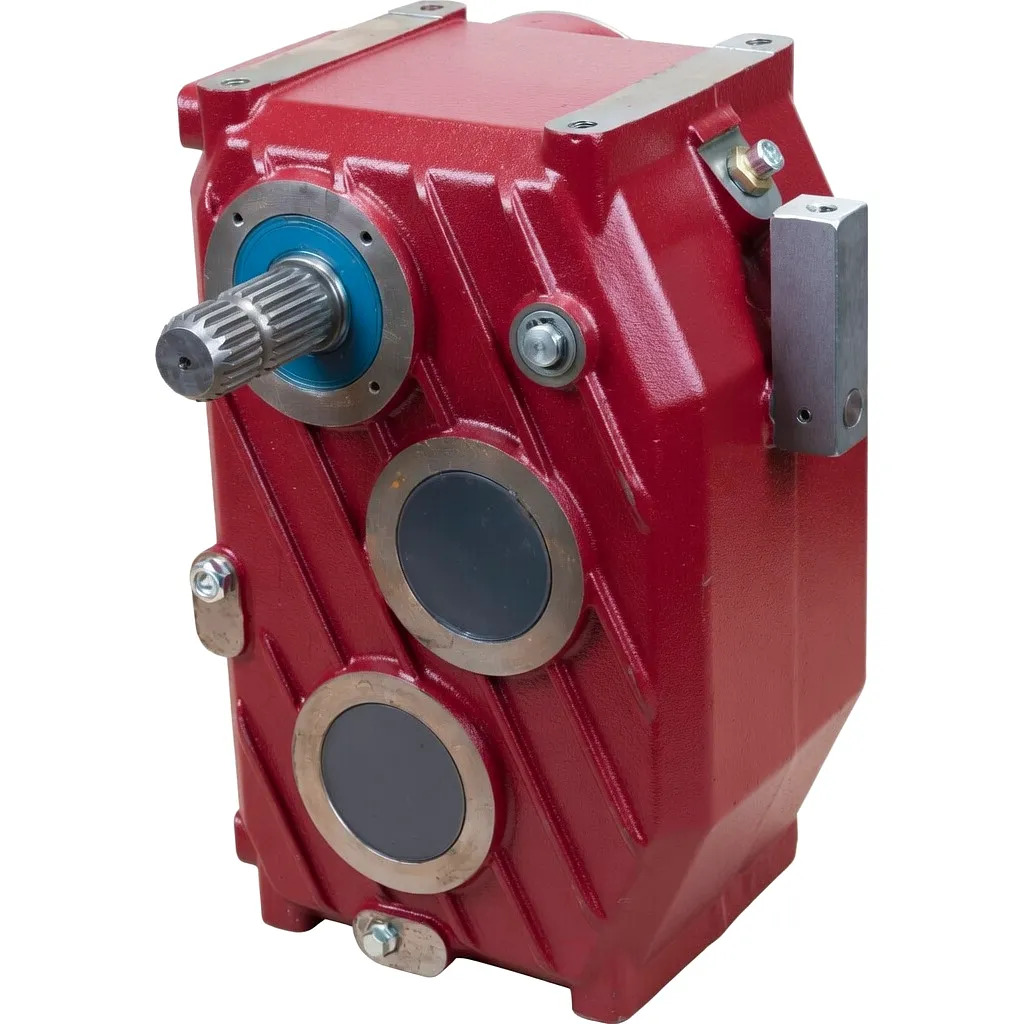 Below the snapping rolls, the stalk rolls rotate in opposite directions to pull the plant stalk downward through the nip point as the ear snaps off at the base of the husks. The counter-rotation of these rolls is achieved through an idler gear arrangement within the row unit agricultural gearbox, and the ability to maintain equal and opposite torque on both rolls is fundamental to the snapping action working cleanly without pulling the whole plant into the row unit or causing kernel loss through an excessive downward pull that detaches the ear from the cob husks. The gear mesh geometry and backlash control within the gearbox housing must therefore be carefully designed and manufactured to ensure that the counter-rotating shafts turn at exactly equal speeds under varying load conditions.
This requirement makes the row unit gearbox a genuinely precision component rather than a simple power transmission device. Backlash values below 0.12 mm at the pitch circle are typical for premium agricultural gearboxes used in corn header applications, and achieving this specification consistently in production demands both high-quality gear cutting and careful housing bore alignment during machining. UK header OEMs and aftermarket suppliers who specify loosely toleranced gearboxes in this application often find that intermittent stalk roll speed inequalities cause wrap-up failures — where a stalk wraps around one roll faster than the other and jams the unit — a problem that costs operators time and frustration during the pressure of the harvest season.
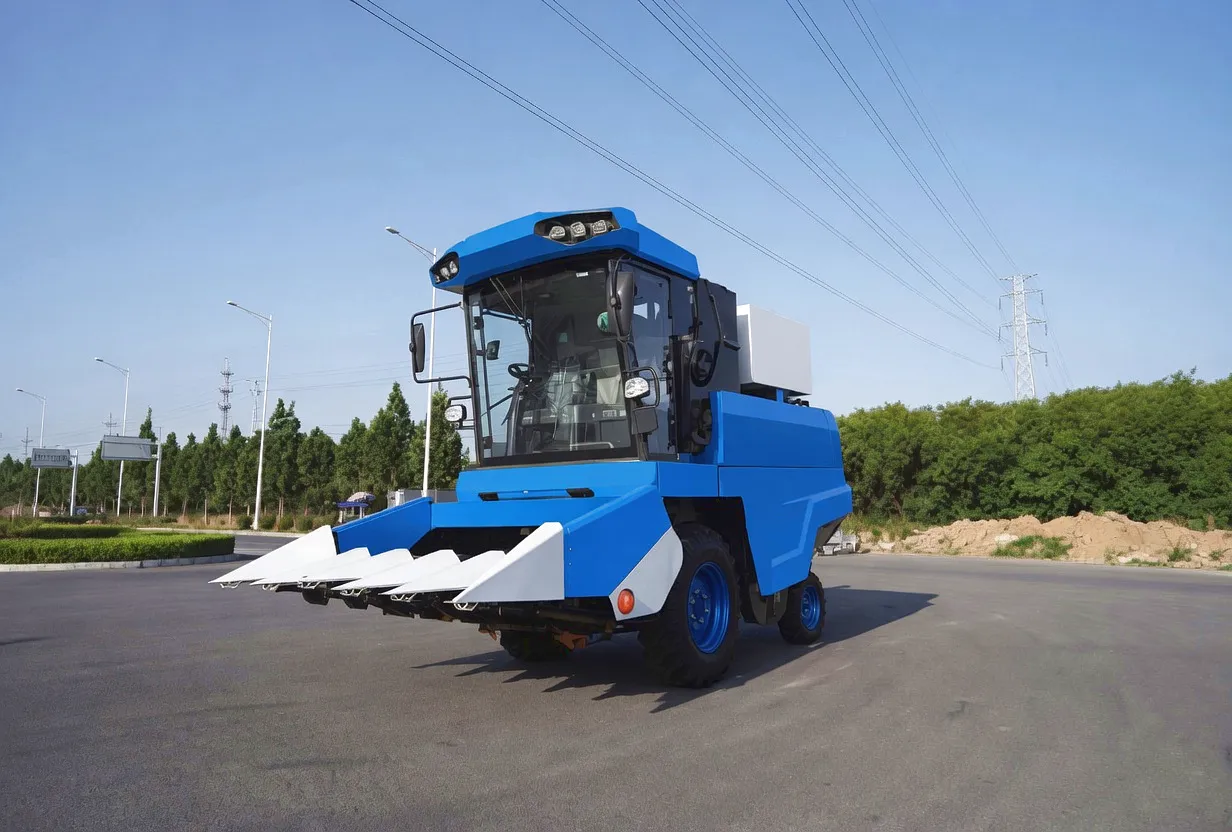 Modern corn headers fitted to Class VIII combines used on the largest UK arable enterprises routinely span eight to twelve rows, with some specialist machines reaching sixteen. Maintaining synchronised drive across all row units requires that each individual agricultural gearbox delivers its output at a consistent speed regardless of the instantaneous load on its particular row. This is why the gear ratio consistency — the deviation in actual output speed from the theoretical value — must be held below 0.5% across all units supplied for a single header, a tight but achievable specification with modern CNC gear hobbing and quality inspection.
Featured Ever Power Agricultural Gearbox Products
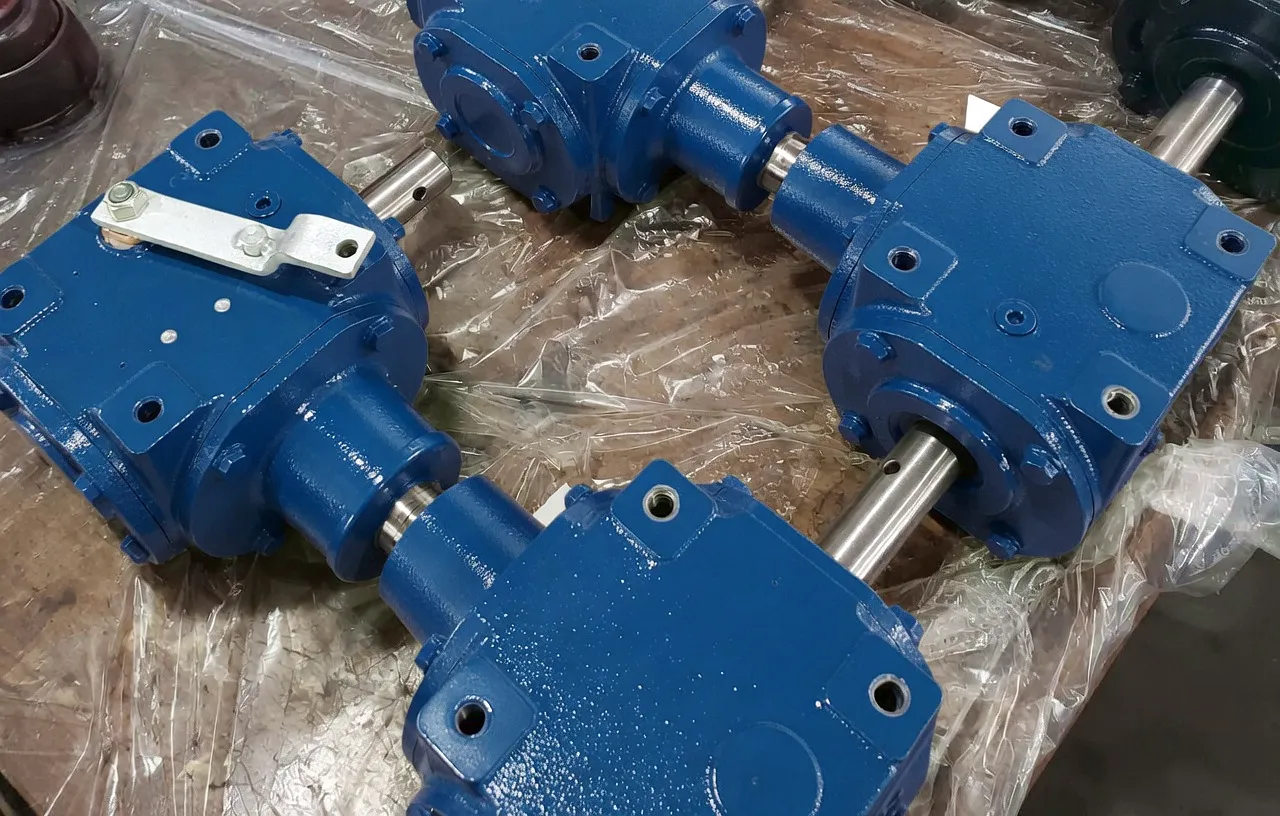
PTO Gearbox
HC-RC31 PTO Gearbox
A robust, compact agricultural gearbox designed for demanding corn harvester row unit applications. Features spiral bevel input stage, case-hardened gear sets in 20CrMnTi, and multi-output configuration supporting snapping rolls and gathering chain drives from a single housing. Compatible with 540 rpm and 1,000 rpm PTO inputs. Rated input torque up to 350 N·m, with a shock service factor of 2.0. Widely used by UK corn header manufacturers and aftermarket suppliers who demand reliable, field-serviceable gearbox performance across full harvesting seasons.
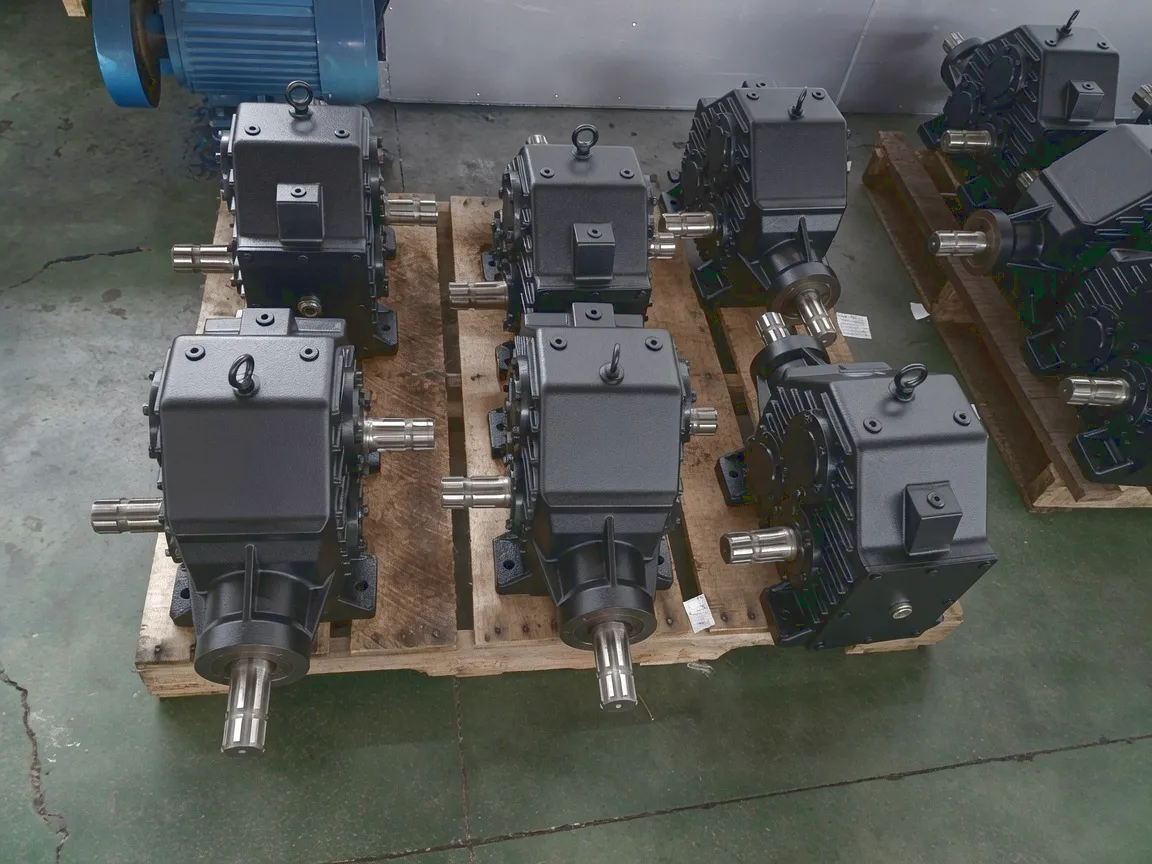
PTO Gearbox
HC-RC30-193 PTO Gearbox
Engineered for multi-row corn headers requiring precise inter-row synchronisation, the HC-RC30-193 delivers tightly controlled output ratios across batch production, with inter-unit speed deviation held below 0.5%. The agricultural gearbox features a reinforced housing in GGG50 nodular iron for enhanced impact resistance, FKM shaft seals for IP65-class environmental protection, and a mounting flange pattern compatible with leading European and UK corn header platforms. Output shafts available in 35 mm, 40 mm, and 45 mm diameters with keyed or splined interfaces to suit diverse roll assembly specifications.
Ever Power: Manufacturing Capability & Customisation Services
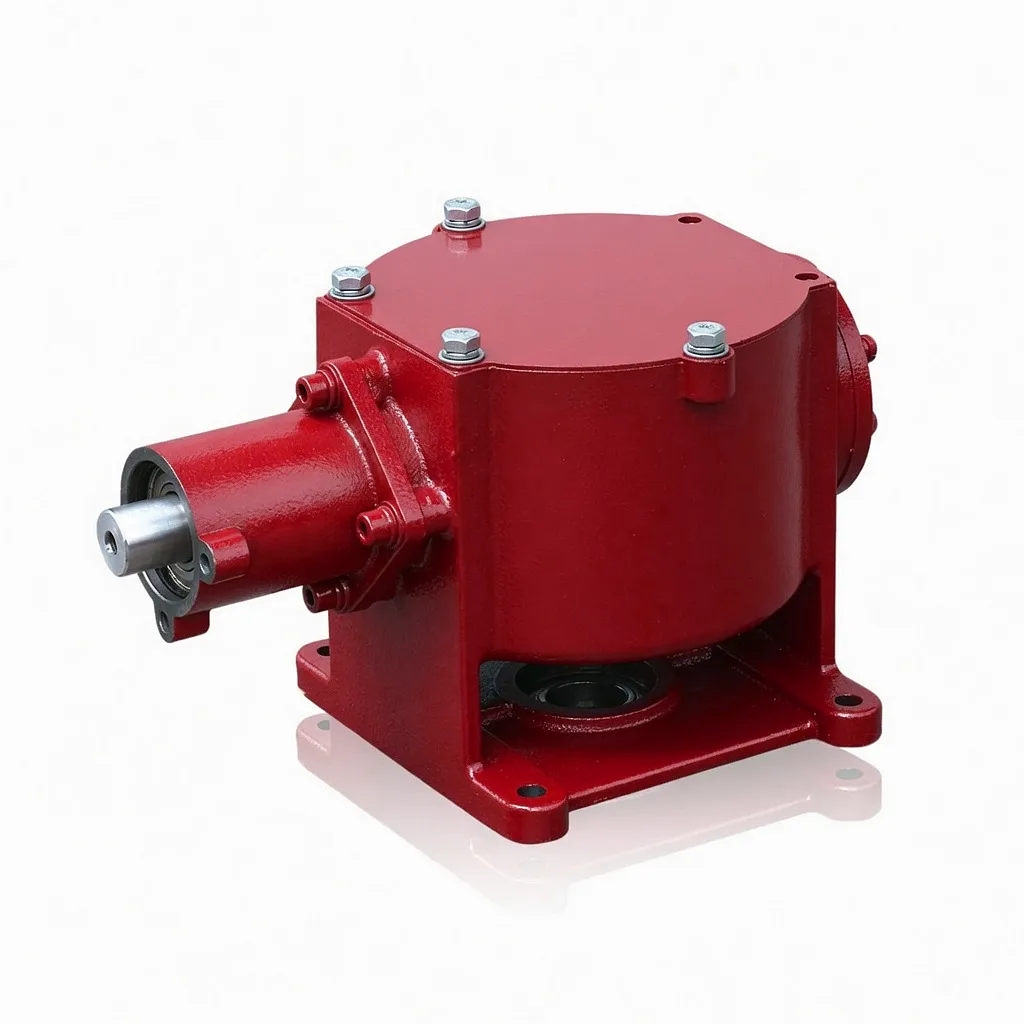 Ever Power has built its reputation in the agricultural gearbox sector through a combination of advanced manufacturing infrastructure and a deeply engineering-led approach to product development. The company’s production facility operates CNC gear hobbing centres capable of ISO Grade 6 accuracy on module 2 to module 8 gears, CNC turning and machining centres with integrated probing for bore position accuracy below 0.02 mm, and dedicated coordinate measuring machines (CMM) that inspect every batch of critical components before assembly. This level of manufacturing precision directly underpins the inter-row synchronisation performance that distinguishes a properly specified row unit agricultural gearbox from a commodity product.
Customisation is central to Ever Power’s service offering. The company supports OEM customers and aftermarket suppliers through the full product development cycle, from initial specification review and FEA stress analysis of proposed gear tooth geometries, through prototype production and field validation, to series production with complete quality traceability. For UK customers, Ever Power provides documentation packages compatible with CE machinery directive requirements, including material certificates, gear accuracy reports, and assembly inspection records — a supply chain capability that simplifies the type approval process for UK agricultural machinery manufacturers operating under post-Brexit UKCA certification requirements.
🏭
Precision Machining
CNC hobbing to ISO Grade 6; CMM 100% inspection of critical bores and gear parameters
⛭
Heat Treatment
In-house carburising and quenching furnaces; controlled case depth ±0.1 mm; hardness 58–62 HRC
📝
OEM Documentation
Material certs, gear accuracy reports, UKCA/CE-compatible quality packages for UK customers
🕔
Short Lead Times
Pre-harvest delivery scheduling for UK seasonal demand; DDP shipping to UK mainland ports available
Ready to Specify Your Row Unit Agricultural Gearbox?
Send Ever Power your drawing or specification and receive a full technical and commercial proposal within 48 hours.
Customer Success Story: Lincolnshire Maize Contractor Reduces Seasonal Downtime by 74%
Lincoln, Lincolnshire — Arable Contracting — Grain Maize & Wholecrop Silage
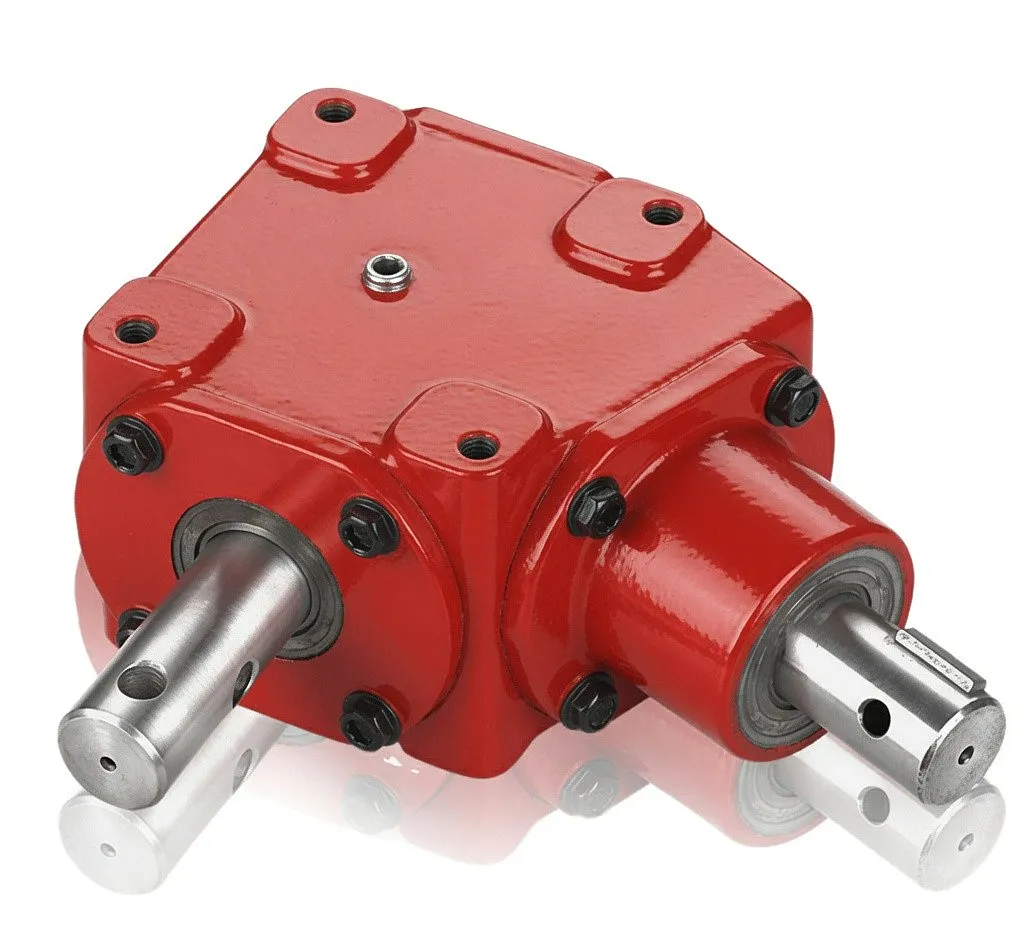 A mid-sized agricultural contracting business operating out of Lincoln, with a harvesting territory covering east Lincolnshire and south Humberside, was running an eight-row corn header on a Class VIII combine during the 2023 maize campaign. The operation covered approximately 1,800 hectares of grain maize and wholecrop silage maize under contract for seventeen farms. The existing row unit agricultural gearboxes — sourced from a low-cost European supplier — had a known history of oil seal failures after 200–300 hours of operation and occasional spiral bevel tooth fractures when the header encountered stony headlands on the light sandy soils around the Lincolnshire Wolds.
After the 2022 season, during which two emergency gearbox replacements required field service visits causing a combined eight-hour harvesting delay across twelve affected farms — at an estimated opportunity cost of over £14,000 in dry-weather harvest capacity — the operator’s workshop manager contacted Ever Power to discuss a full set of replacement row unit gearboxes. Ever Power supplied eight HC-RC31 units and two HC-RC30-193 units for the outer row positions, all specified with FKM seals, GGG50 nodular iron housings, and carburised 20CrMnTi gear sets. The order was delivered DDP to Lincoln four weeks ahead of the 2023 harvest season, with a full technical installation guide and a spare parts kit.
Across the entire 2023 maize campaign — 1,840 harvested hectares — the contractor reported zero gearbox-related stoppages. Spot oil checks at the 300-hour and 600-hour marks showed oil in good condition with no evidence of seal leakage or metallic contamination. The workshop manager attributed an estimated 74% reduction in seasonal gearbox-related downtime compared with the 2022 campaign, representing a significant improvement in machine availability during the narrow autumn harvest window. The contractor placed a repeat order for the 2024 season and extended the evaluation to a second eight-row header in the fleet.
What UK Operators Say About Ever Power Agricultural Gearboxes
“
The seal quality on these gearboxes is a step above anything we used before. We did 650 hours through the 2023 season across two headers and not a single drop of oil on the ground. For anyone running maize in Lincolnshire, that kind of reliability is worth paying for — you cannot afford a row unit failure when the weather finally gives you a window.
— Workshop Manager, Arable Contracting Business, Lincoln, Lincolnshire
“
We specified a custom ratio on the outer two row units to compensate for the speed difference at the header ends during our 10-row configuration build. Ever Power turned this around in four weeks including the machining change — no other supplier we contacted could commit to less than ten weeks. The inter-row speed consistency is measurably better than our previous design, with kernel scatter loss down noticeably on high-throughput days.
— Technical Director, Agricultural Machinery Manufacturer, Sheffield, South Yorkshire
“
The documentation package Ever Power supplied — material certs, gear accuracy reports, CMM inspection data — made the UKCA certification process for our new header platform considerably more straightforward. As a UK manufacturer, having that level of traceability from our gearbox supplier is genuinely valuable. The gearboxes themselves have performed flawlessly in our field validation trials across the East Midlands test farms.
— Head of Engineering, Agricultural Equipment OEM, Nottingham, Nottinghamshire
Frequently Asked Questions
What is the typical price range for a replacement row unit agricultural gearbox for a UK corn header, and where can I get a competitive quote?
Replacement row unit agricultural gearboxes for corn headers vary considerably by specification. Entry-level units for smaller five- or six-row headers start from around £180–£320 per unit for standard spiral bevel designs, while premium multi-output gearboxes for eight- to twelve-row headers on Class VII–VIII combines typically range from £400 to £850 per unit depending on ratio, output count, and housing material. For an accurate quote matched to your specific header model and operating requirements, contacting Ever Power directly at [email protected] is the most efficient route — the team can usually provide a detailed proposal within 48 hours of receiving your drawing or unit dimensions.
How do I know which gear ratio to specify when sourcing a row unit gearbox for a corn harvester operating in the UK at typical maize harvest speeds?
The correct gear ratio is determined by the target snapping roll peripheral speed — typically 2.5 to 4.5 m/s — divided by the roll diameter and matched to the machine’s operating forward speed, usually 5 to 8 km/h for UK maize conditions. Most UK grain maize crops perform best with roll tip speeds around 3.0–3.8 m/s to achieve clean ear separation without over-aggressive stalk pull. Wholecrop silage maize, which is cut wetter and at higher moisture, may benefit from slightly lower roll speeds. Ever Power’s technical team can run through the ratio selection calculation with you if you provide the roll diameter, desired operating speed, and PTO input frequency.
Which agricultural gearbox supplier in the UK or Europe can provide custom row unit gearboxes with short lead times before the autumn maize harvest season?
Ever Power is a specialist agricultural gearbox manufacturer with the in-house CNC gear cutting, heat treatment, and assembly capability to deliver custom row unit gearboxes with lead times as short as four to six weeks for series production runs. For UK customers, the company offers DDP shipping to mainland UK ports, pre-harvest delivery scheduling, and full documentation packages. Standard catalogue variants of popular row unit configurations are held in semi-finished stock, reducing delivery times further for urgent pre-season requirements. Contacting the sales team in June or July — ahead of the August–October UK harvest period — is strongly advised to secure manufacturing slots.
What causes agricultural gearbox oil seal failures on corn harvesters in Lincolnshire and how can I prevent them when choosing a replacement unit?
Oil seal failures in row unit agricultural gearboxes are most commonly caused by three factors: maize silk ingress at the output shaft seal lip, centrifugal oil sling exceeding the sealing capacity of single-lip designs at high roll speeds, and thermal cycling that hardens NBR seal material over multiple seasons. Choosing a gearbox fitted with FKM (Viton) double-lip output shaft seals and a labyrinth pre-seal provides substantially better resistance to all three failure modes. Additionally, correct oil level — neither over-filled nor under-filled — reduces the internal pressure that forces oil past the seal lips. Any premium agricultural gearbox destined for UK maize applications should carry at minimum an IP54 sealing rating, with IP65 preferred for operators in the wetter western counties.
When should I consider replacing rather than repairing an agricultural gearbox on a corn header running across Yorkshire or East Midlands farms?
Replacement rather than repair becomes the cost-effective choice when an agricultural gearbox shows gear tooth pitting covering more than 10% of the tooth face area, backlash at the output shaft that has increased beyond 0.25 mm at the pitch circle, or a housing crack even if currently non-leaking. Repair costs for quality bevel gear sets — including re-lapping and shimming — often approach 60–80% of a new unit price once labour is factored in, and a repaired unit rarely returns to original performance. For UK contractors where a harvesting day has an opportunity cost of £8,000–£20,000 across a busy autumn campaign, the insurance value of a new agricultural gearbox with a known service history is straightforward to justify.
Who are the most reliable agricultural gearbox suppliers for UK corn header OEMs looking to source row unit gearboxes with UKCA-compatible quality documentation?
For UK corn header manufacturers and aftermarket engineers requiring gearbox components with full material traceability and documentation aligned to UKCA certification processes, the key supplier attributes to look for are: EN ISO 9001 quality management certification, CMM-based dimensional inspection reports included as standard with each delivery, and gear accuracy reports per ISO 1328 or equivalent. Ever Power provides all of these as part of its standard OEM supply package, along with the flexibility to accommodate drawing-specific customisations in ratio, output configuration, and housing dimensions. The company has an established track record supplying agricultural gearbox components to manufacturers across the UK and mainland Europe and can provide reference contacts on request.
© Ever Power — Agricultural Gearbox Specialists | [email protected] | edit by gzl